Delhi Metro card: smart card, NCMC and QR tickets
What each way of paying on the Delhi Metro costs, how much it saves and where you buy it — with the DMRC page or press release behind every figure.
Ways to pay on the Delhi Metro
| How you pay | What it costs | Discount on the fare | Where you get it |
|---|---|---|---|
| DMRC smart card | ₹150 to buy (₹50 refundable deposit + ₹100 of travel) | 10% off every fare, 20% off-peak (Mon–Sat) | Customer care centre or card vending machine at a station |
| Virtual smart card (in DMRC's app) | ₹150 to open, no deposit | The same as the plastic card | Delhi Metro Sarthi app only |
| NCMC bank card | What your bank charges for the card | 10% off at peak times, 20% off-peak | Banks; some banks' cards at station counters |
| Tourist card | ₹200 for one day, ₹500 for three (₹50 of it a refundable deposit) | Unlimited rides instead of a discount | Station counters, except on the Airport Express |
| QR ticket in an app | The ordinary fare, ₹11 to ₹64 | None | Delhi Metro Sarthi, WhatsApp, Paytm, One Delhi, PhonePe, Amazon Pay and others |
| Paper QR ticket or token | The ordinary fare | None | Ticket window or customer care centre |
Prices are DMRC’s, from its fare, smart card, NCMC and tourist card pages, read on 20 October 2026. Metro fares themselves have been unchanged since 25 August 2025 and go by distance: see Delhi Metro fares for the six slabs and the cheaper Sunday fares.
Two things are worth knowing before you choose. First, the discount is not a loyalty scheme: a smart card, a virtual card or an NCMC takes 10% off every single fare, and twice that outside the busy hours, so for anything more than one trip it pays for itself. Second, DMRC publishes no daily cap and no weekly or monthly pass for the metro, and no student, senior citizen or child concession either (the Airport Express is the exception: it sells 30 and 45-trip cards good for a calendar month). The only reductions DMRC publishes are the card discount, the lower Sunday and national-holiday fares, and the tourist card. If someone offers you a Delhi Metro season ticket, it is not a DMRC product.
The DMRC smart card
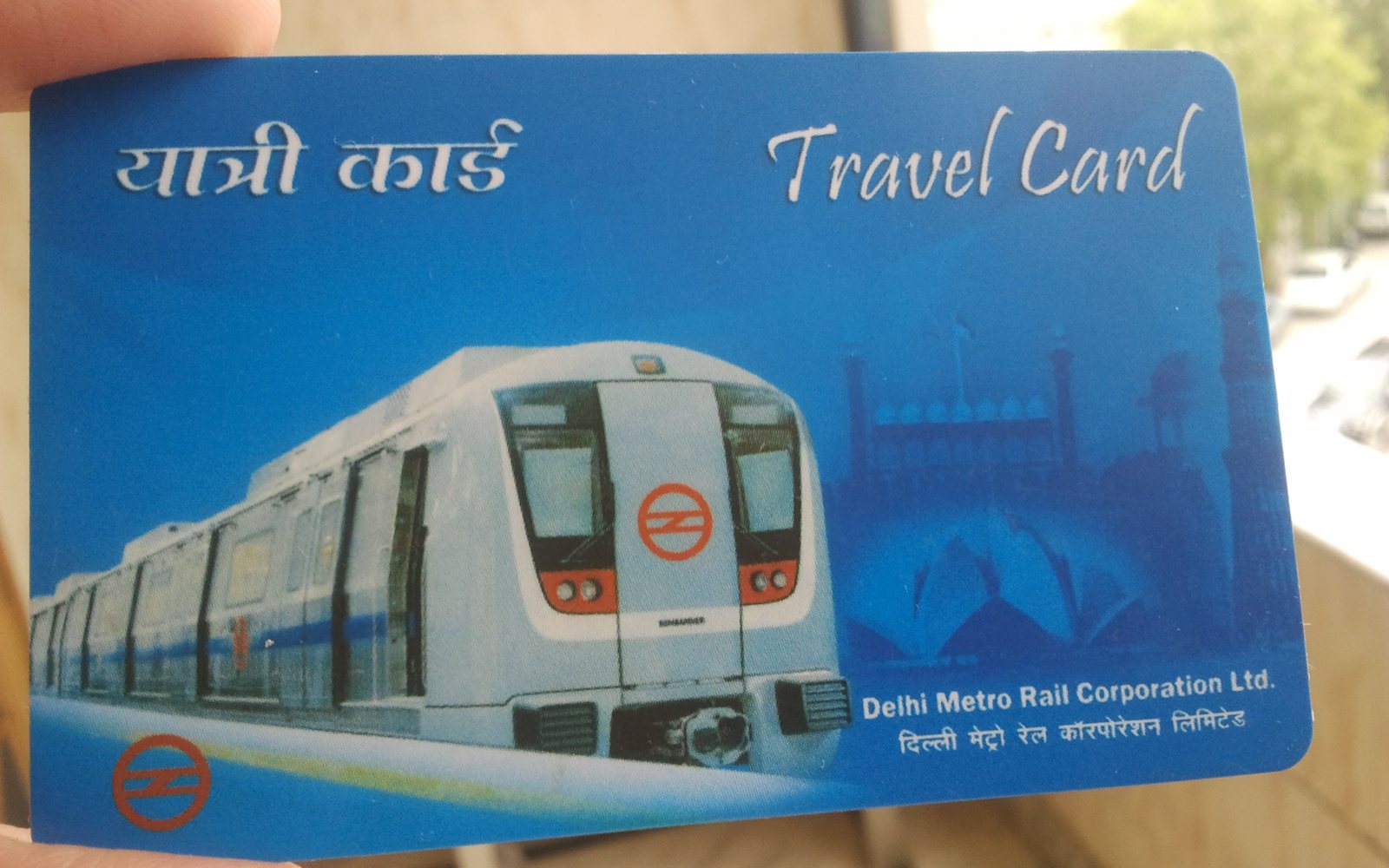
The smart card — DMRC prints “Travel Card / यात्री कार्ड” on it — is the card you buy at the station and tap on the gate. It costs ₹150: ₹50 of that is a security deposit and ₹100 is travel money. DMRC’s own benefits list is short and accurate: you save time, you skip the ticket queue, you can enter and leave at any station, and you get a minimum discount of 10% on every journey.
On top of that there is a second 10% if you enter the paid area outside the busy hours, Monday to Saturday except on the three national holidays. The two together are the “20% off-peak discount” DMRC advertises on its ticket machines.
The card holds up to ₹3,000 and is valid for ten years from purchase or last recharge. DMRC also says it works on DTC, Cluster and Metro feeder buses. It is not personalised: it is transferable and anyone can travel with it, though only one person at a time, and every entry has to be followed by a proper exit.
| Off-peak from | Until |
|---|---|
| Start of service | Before 08:00 |
| 12:00 noon | Before 17:00 |
| 21:00 | Close of service |
DMRC smart card page, read on 20 October 2026. Peak hours on the rest of this site — 08:00 to 12:00 and 17:00 to 21:00 — are the mirror image of this table.
Where to buy a smart card and how to top it up
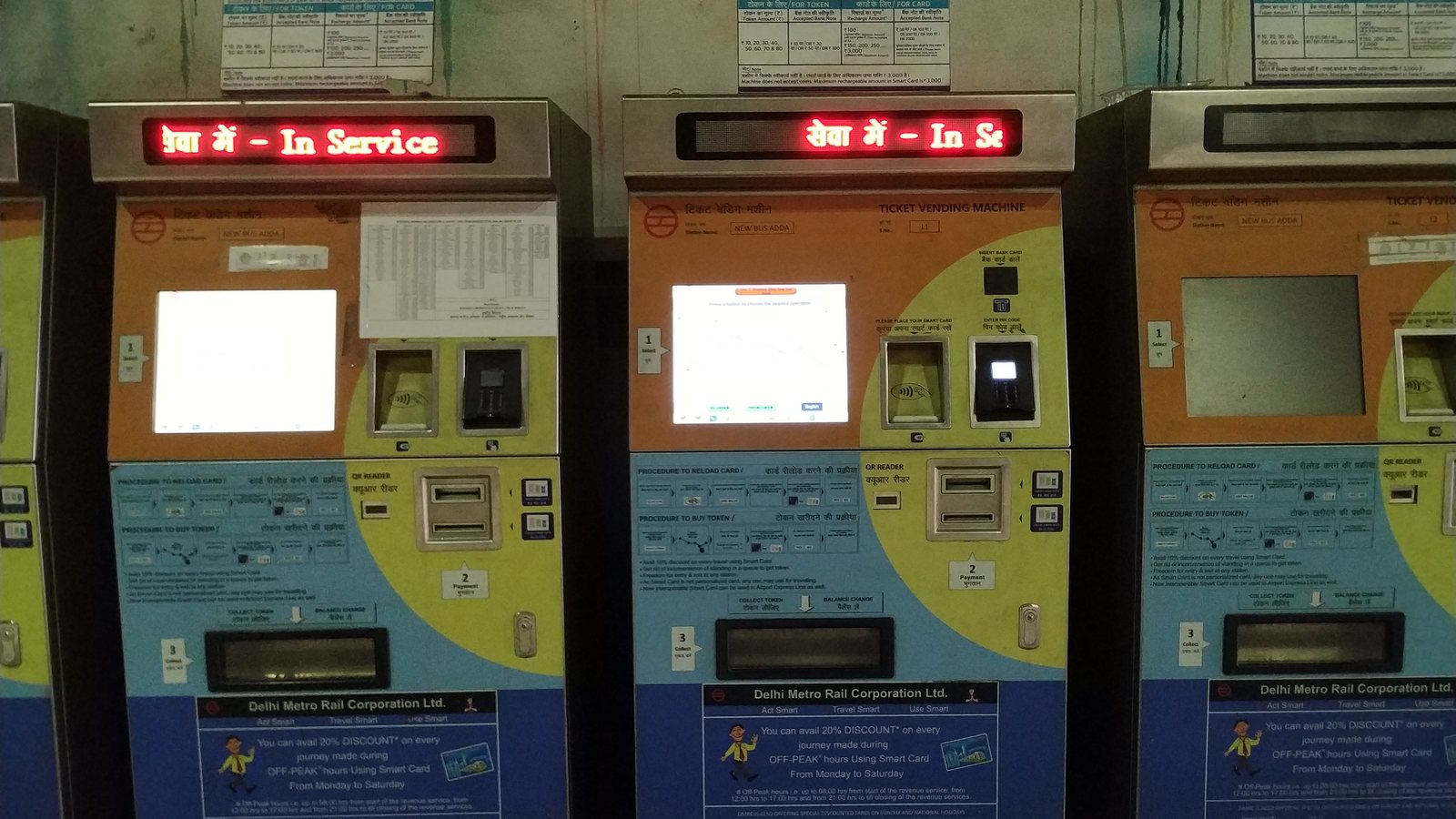
DMRC sells the card at a customer care centre (the counter inside the station) and from card vending machines. The same machines reload it, and the minimum you can add depends on where you do it:
| Where you add value | Minimum | Then in steps of |
|---|---|---|
| Customer care centre (the counter) | ₹200 | Multiples of ₹100 |
| Ticket vending machine | ₹100 | Multiples of ₹50 |
| Credit or debit card | ₹200 | Multiples of ₹100 |
Away from the station, DMRC lists online recharge through its portal www.dmrcsmartcard.com, recharge by SMS for ICICI Bank account holders, and app recharge: its own app does card top-ups, and since January 2023 so does Airtel Payments Bank’s app. Whichever you use, the money is not on the card until you tap it on an Add Value Machine at a station — DMRC’s own three-step description ends with “tap the smart card on Add Value Machine at the metro station to sync the card before usage”.
DMRC’s app can also do it automatically: when it launched Momentum 2.0 in November 2023 DMRC said commuters can “give standing instructions in the App for Auto Top Up in case the balance falls below a minimum defined value”. DMRC does not publish what that minimum is, or how much is then added, so we cannot tell you — the app does, when you set it up.
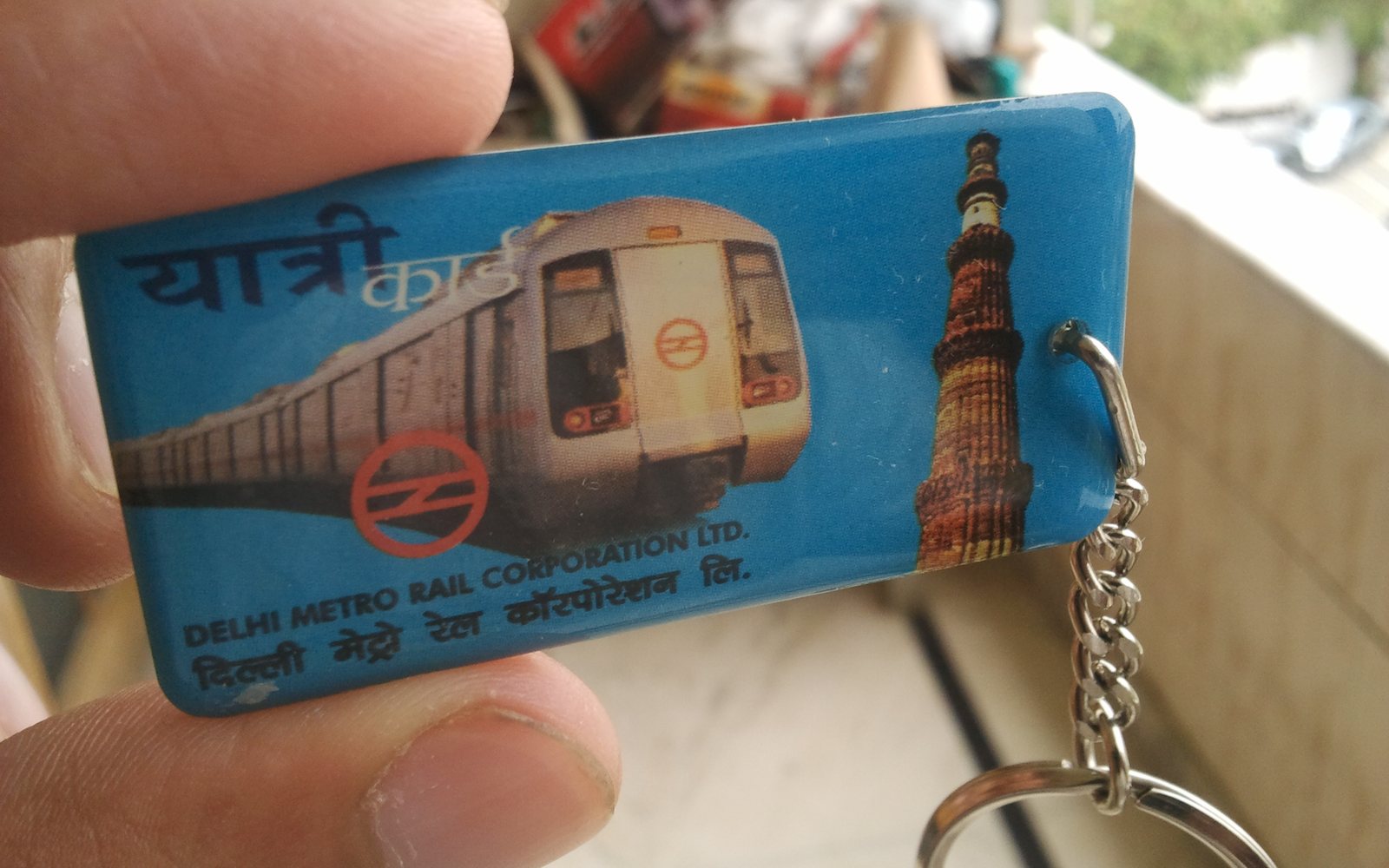
DMRC has sold the same card in other shapes: this key fob is a smart card too, and DMRC has also issued “combo” cards with banks. They work exactly like the blue card at the gate.
One more thing the counter can do for you and a machine cannot: an NCMC bank card has to be activated at a customer care centre the first time (see below).
DMRC smart card page and the press releases of 29 January 2023 (Airtel Payments Bank top-up) and 1 November 2023 (Momentum 2.0), read on 20 October 2026.
The same card on your phone
DMRC has a card with no plastic. Its rulebook calls it the Virtual Smart Card; the press release that launched it on 12 September 2024 calls it the Multiple Journey QR Ticket (MJQRT), and the numbers in the two descriptions match, so they are the same product under two names. It lives in DMRC’s own app and shows a QR code at the gate instead of a card.
- You open it with ₹150 of travel money and no security deposit.
- You add value in multiples of ₹50, up to the same ₹3,000 ceiling as the plastic card, from inside the app — in the paid area or outside it.
- The discount is the same as on the plastic card: 10% at peak times, 20% off-peak.
- It is valid for five years from your last top-up. After that it is dead, and DMRC says the balance is forfeited.
- The balance is never refunded, and a top-up cannot be cancelled.
- It does not work on the Airport Express.
- If your phone is lost or broken you do not lose the money: log in on another phone with the same credentials. But if it dies while you are inside the system, DMRC treats you as travelling without a ticket and the staff issue a paid exit ticket.
The app itself has changed name more than once, which makes it easy to install the wrong thing: DMRC launched “DMRC Travel” in June 2023, “Momentum 2.0” in November 2023, then “DMRC Momentum दिल्ली सारथी 2.0”, and in October 2026 it reports a crore of downloads for Delhi Metro Sarthi. Check that the publisher is Delhi Metro Rail Corporation before you install.
DMRC Virtual Smart Card business rules and the press releases of 12 September 2024 (MJQRT) and 1 October 2026 (Sarthi app), read on 20 October 2026.
NCMC: a bank card that works on the metro
The National Common Mobility Card is the government’s “One Nation, One Card”: a RuPay card issued by a bank that also works as a transit card. DMRC accepts all banks’ NCMCs on its network and on the Airport Express, and gives 10% off at peak times and 20% off-peak — the same discounts as DMRC’s own card, on a card that also works on the metros and buses of other Indian cities.
Three practical points from DMRC’s page:
- The first time you use one on the metro, a Common Service Area has to be created on the card at a DMRC customer care centre. It is done once, and not again if another transit operator has already done it.
- You add value from the linked bank account or with cash at a customer care centre: minimum ₹200, then in multiples of ₹100.
- Validity is whatever is printed on the card.
You can buy one at a bank, and selected banks’ cards are sold at metro station counters. In May 2026 DMRC and Airtel Payments Bank launched co-branded RuPay “On-The-Go” NCMC cards, sold at DMRC stations and rechargeable from the DMRC or Airtel app; DMRC said then that existing cards keep working.
DMRC National Common Mobility Card page and the press release of 10 May 2026, read on 20 October 2026.
The tourist card
If you are in Delhi for a few days and plan to use the metro all day, the tourist card is the one product that is not fare-by-fare. DMRC sells it in two versions:
- One day — ₹200 (₹150 of travel plus a ₹50 refundable security deposit).
- Three days — ₹500 (₹450 plus the same ₹50 deposit).
When DMRC put these cards on sale for the G-20 summit it described them as “offering unlimited rides in the Metro network”, usable “from the first train to the last train service available for the day”, with no penalty or surcharge for an entry/exit mismatch or for overstaying in the system. That press release also says they are sold at all metro stations except the Airport Express Line, at any time of day.
On refunds DMRC is blunt: the travel value in a tourist card is not given back, and only the ₹50 deposit is returned, against a card that is readable and physically undamaged.
DMRC tourist card page and the press release of 3 September 2023, read on 20 October 2026.
QR tickets, in the app and on paper
For a single journey, the Delhi Metro now runs on QR codes. There are three kinds and they are not quite the same thing.
In an app. DMRC lists its own Delhi Metro Sarthi, WhatsApp (send “Hi” to 9650855800), Paytm, One Delhi, Amazon Pay, PhonePe, the web page qrticket.dmrc.org and IRCTC for railway passengers. Since joining the ONDC network, DMRC says tickets can also be bought in more than ten other apps, among them Google Maps, Rapido, redBus, NammaYatri and Tummoc. You pick origin and destination, pay, and scan the code at the gate. You can only enter at the station you chose, but you may leave at that station, at any station before it, or at any station with the same fare. You cannot buy the next ticket until the last one has been used or has expired.
On paper, at the counter. Up to 99 tickets in one go, never for the station you are standing in, valid only on the day it is issued, and you have to scan it to get in at that station. There is no duplicate if you lose it: DMRC says keeping it until the end of the journey is your job.
Tokens. The plastic disc is still in DMRC’s rules — hold it against the reader to get in, drop it in the slot on the way out — and its ticket machines still carry a “procedure to buy token” panel. DMRC’s own token page, however, is empty, so we cannot tell you from an official source which counters still sell them today.
| QR ticket | How long you have inside | If you enter and leave at the same station |
|---|---|---|
| In an app, on the metro network | 65, 100 or 180 minutes, by fare | 20 minutes |
| On paper, at the counter | Up to 180 minutes | 20 minutes |
| On the Airport Express | 65 minutes | 30 minutes |
If an app took your money and no ticket appeared, DMRC says to raise it in the app’s support section or by email through its digital feedback book, and that the refund arrives in three to seven business days; if a technical problem stopped you travelling, complain within an hour of buying the ticket. And if your phone is lost, flat or broken when you reach the gate, with a QR ticket you are treated as travelling without a ticket.
DMRC app-based and paper QR ticketing pages, the token and recharge page and the press release of 15 May 2025 (ONDC), read on 20 October 2026.
What changes on the Airport Express
The Airport Express Line has its own fare table, from ₹11 to ₹75 for a single trip, and its own products:
- QR tickets, in the Delhi Metro Sarthi, WhatsApp, Paytm and PhonePe apps, for up to 6 passengers at a time. DMRC sells them from 04:00 until ten minutes before the last advertised train.
- 10, 30 and 45-trip cards between a fixed pair of stations. The 10-trip card is valid for 15 days and the other two for a calendar month. New Delhi to the airport, for example, is ₹64 as a single QR ticket or ₹490 for ten trips.
- NCMC cards: DMRC says all banks’ NCMCs are accepted “in DMRC network/Airport line”, on the same page that gives the 10% and 20% discounts.
- The virtual smart card does not work here — DMRC says so in its first line of rules.
The plastic smart card is the awkward case. A notice printed on DMRC’s ticket machines says “now interoperable Smart Card can be used in Airport Express Line as well”, and the photograph of it on this page is from 2022. But DMRC’s Airport Express fare page publishes only QR and trip-card prices and says nothing about a card discount, so we will not tell you what a smart card pays there. Tourist cards are explicitly not sold on this line.
DMRC Airport Express fare page and its QR ticketing page for the Airport Line, read on 20 October 2026. The full station-by-station table is on the Airport Express page.
Refunds, expiry and losing your card
DMRC explains refunds in a flow chart titled “Information on Non-refundable Smart Card”, linked from its smart card page. In its own terms:
- A readable card in good physical condition gets ₹30 back at a customer care centre — less than the ₹50 the same page calls a security deposit, and DMRC does not explain the difference. If the card is in debt, the amount owed comes off that ₹30.
- A readable but physically damaged card: nothing is refunded.
- A card the machines cannot read is handed in at the counter. The deposit is returned there and then only if the card is physically undamaged; the travel money on it has to be claimed afterwards, by validating another smart card on an Add Value Machine after 5 days and within 90 days of handing the old one in. If you do not have a second card, you buy one.
Expiry. The smart card is valid ten years from purchase or from the last recharge, so a card you keep topping up does not expire. The virtual card dies five years after the last top-up and the balance is forfeited. A tourist card’s travel value is never refunded. A paper QR ticket is dead at the end of the day it was issued.
DMRC smart card page and its “Information on Non-refundable Smart Card” flow chart, Virtual Smart Card rules and tourist card page, read on 20 October 2026.
What the gates charge you for
| Situation | What DMRC charges |
|---|---|
| Travelling without a valid ticket | excess charge ₹50 plus the maximum fare of the system (Sec. 69) |
| Entering the coach reserved for women | ₹250 (Sec. 64(1)) |
| Return journey: leaving in the direction you came from | ₹50 |
| Pseudo entry or exit at the gates | ₹80 |
| Entering and leaving at the same station, on a card | ₹10 |
| Staying inside longer than your ticket allows | ₹10 an hour, up to ₹50 |
DMRC penalties page (fines under the Delhi Metro Railway Act, 2002 and the business rules) and its token/cards and recharge page, read on 20 October 2026. How long you may stay inside depends on the fare you paid: the slabs are on Metro fares.